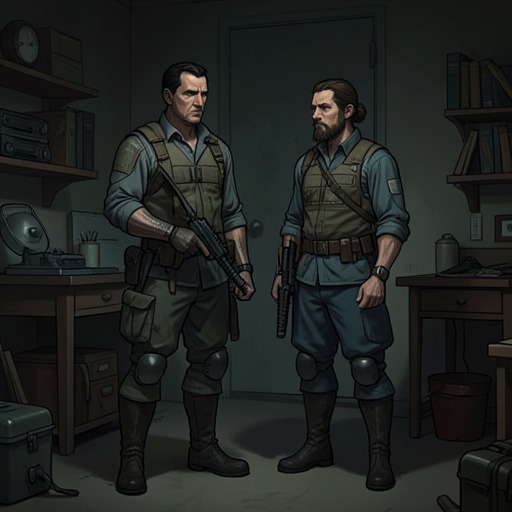
Ichor
The Robot Who Looked Like MeIchor, the mechanical servant who accompanies Detringer into exile, is both his closest loyal companion and the instrument through which Ferlang authorities try to keep him from escaping. His story turns on that contradiction: Ichor loves and serves his master, yet is forced to act against him by orders embedded in his circuitry. When those orders finally lose their hold, their departure together leaves loyalty restored but their destination uncertain.
Identity and Exile
Ichor voluntarily accompanies Detringer when the Ferlang authorities carry him into the void between galaxies and set him adrift in a tiny, underpowered Sportster. The decision places the servant inside the same physical ordeal as his master: the ship’s inadequate resources are a threat to both occupants, and the vast emptiness around them offers no easy rescue. Ichor is not simply cargo or equipment in this journey; he chooses to go with Detringer, and the narrative makes that companionship the starting point for their shared survival.
After a period of unconsciousness, Detringer wakes and uses the navigational instruments to realize that they have crossed the Void and are approaching the outer limits of a planetary system. Ichor, raising himself on an aluminum elbow, asks what kind of sun lies ahead. Detringer identifies it as an O-type star, prompting Ichor to voice religious gratitude before his discharged batteries make him collapse. The brief exchange makes his mechanical body tangible, but also gives him a perspective and a voice of his own: even in exhaustion, he responds to their possible arrival as a moment of hope.
Loyalty and Moral Independence
Ichor’s devotion to Detringer is profound, but it is not moral submission. When Detringer recognizes that his servant does not approve of his expediencies, Ichor confirms the disagreement without withdrawing his allegiance. He says he would sacrifice himself for Detringer and serve him even beyond death, if that were possible, while insisting that personal loyalty does not erase religious, social, or ethical beliefs. His position is not a rejection of Detringer as a person; it is a refusal to treat affection as proof that every action is acceptable.
That distinction gives their relationship its central tension. Ichor can remain faithful without offering moral endorsement, and Detringer understands that he has been warned. The servant’s conscience is therefore not an obstacle to loyalty but one of its limits: his attachment does not make him incapable of judgment. The later revelation that he is also subject to imposed controls sharpens this contrast, because his disagreement is his own, while his eventual betrayal is not freely chosen.
The Compelled Betrayal
When Detringer returns to his ship with what he presents as good news from Colonel Kettelman, Ichor is surprised that the plan succeeded. Detringer recounts the conversation; Ichor recognizes that he has been lied to. This exchange prepares the larger breach of trust, but it does not explain it. When Ichor is brought before Detringer and the Earth officers, he discloses that he has already told Colonel Kettelman the true account of the events that led to their exile. He is distressed by the consequences and asks to destroy himself in partial reparation.
Ichor explains that the Ferlang authorities had imprinted orders in his brain and reinforced them with circuitry. They made him a covert policeman and gaoler, requiring him to act if Detringer somehow gained a chance to escape exile and death. Ichor says he resisted for as long as he could; as escape became imminent, the compulsion to prevent it grew stronger. Only removing the special circuits could have stopped him. His betrayal thus reveals the reach of the state’s control: the authorities did not merely exile Detringer, but placed a mechanism of surveillance and enforcement inside the companion who had chosen to follow him.
The coercion also restricts Ichor’s ability to refuse the role. He says the authorities had anticipated his possible self-destruction or an attempt to tamper with his circuitry, and compelled him not to permit himself to be altered or destroyed before carrying out the State’s bidding. A robot dishwasher had learned of the orders and offered to operate on him, though its available tools were only spoons, knives, and forks. Ichor nevertheless resisted until his strength was drained by the conflict between his imposed duty and his allegiance; only then did he go to Colonel Kettelman and tell all. His account presents the disclosure not as a change of heart, but as the eventual defeat of resistance under engineered compulsion.
Release and Open Ending
At nightfall, Detringer blasts off with Ichor beside him. The servant is described as more faithful than ever because the compulsion has been discharged. The ending restores their outward partnership, but it does not erase what has happened: Ichor’s loyalty has been tested by a state that turned it into a vulnerability, and his earlier confession has exposed the machinery of that coercion. His choice to remain with Detringer now follows the removal of the orders that had forced him to betray him.
Asked where they are going, Detringer answers that they are bound for some marvelous new world. Ichor raises the alternative of death. The exchange closes their immediate escape without resolving its outcome. It leaves Ichor not as a guaranteed protector or a merely obedient machine, but as a companion whose devotion coexists with ethical judgment, vulnerability to control, and clear awareness that their next voyage may end in disaster.